

Reasons to Hike in the Camino Portuguese Central
✓ Walk a lesser-known Camino route, peaceful, authentic, and uncrowded
✓ Scenic trails through Galicia, green hills, ancient villages, and quiet countryside
✓ Optional Camino Espiritual route, even more secluded and spiritually enriching
✓ Cross-border adventure, journey from Portugal into Spain
✓ Easy logistics, convenient access to the start and end points
✓ Cultural discovery, explore the layered history of the Iberian Peninsula
✓ At the end of the journey, every traveler who completes the route will receive the Compostela, the official certificate of pilgrimage to Santiago de Compostela!
Itinerary of the Camino Santiago Portuguese Central Way

157
KM
9
Nights
10
Days
Day 1: Ponte de Lima
Welcome to the Camino Santiago!
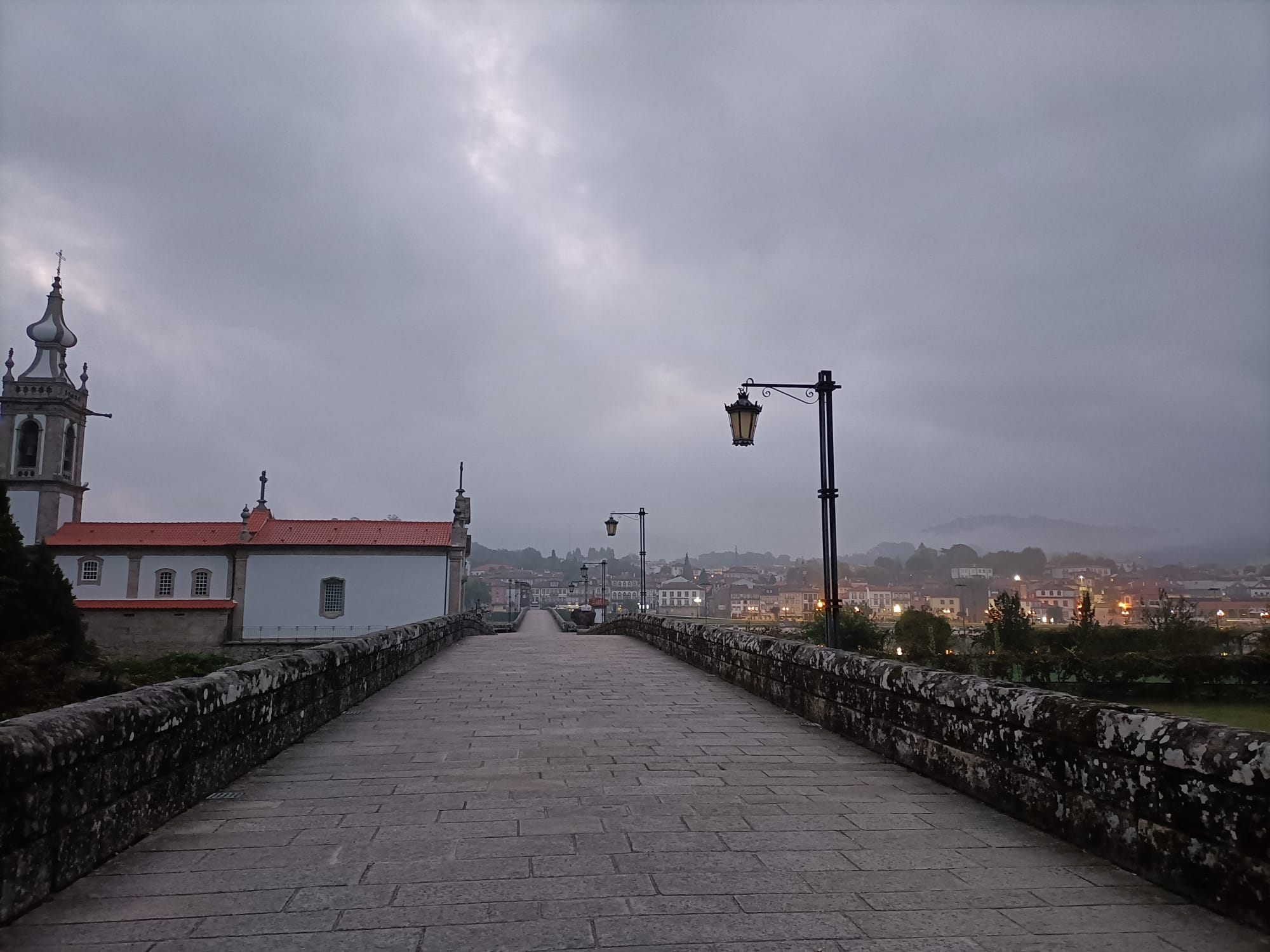
Your Camino begins in the charming town of Ponte de Lima, considered the oldest town in Portugal, with roots that go back to 1125. Before setting off, you’ll receive your Camino tour kit, including your pilgrim passport and other useful items for the journey. We recommend arriving in Porto the day before to ensure a smooth transfer to Ponte de Lima.
This historic town sits along the ancient Via XIX, a Roman road built in the 1st century AD that once connected Bracara Augusta (Braga) to Asturica Augusta (Astorga). As you cross the iconic Roman medieval bridge over the River Lima, the Camino immediately immerses you in a landscape where stone, history and silence meet.
—
Accommodation: Ponte de Lima
Day 2: Ponte de Lima, and walking to Rubiães
Good morning, the trail begins gently, surrounded by green fields and ancient granite walls, but soon leads you into the Serra da Labruja, the most demanding ascent of the Portuguese Central Way. The path is rocky and steep, flanked by boulders worn by centuries of pilgrims, and marked by crosses, milestones and small offerings left along the way.
At the base of the climb, it’s tradition to pick up a stone from the path, symbolizing your burdens or intentions, and carry it with you to leave at the Cruz dos Mortos (Cross of the Dead) or Cruz dos Franceses (Cross of the French), a place where local resistance once ambushed Napoleon’s troops in 1809.
At the summit, you’re rewarded with sweeping views, and from there, the descent to Rubiães is calm.
—
Approximate walking profile
Difficulty level: Medium
Distance: 19 km
Highest point: 408 masl
Lowest point: 0 masl
Elevation Gain: 500 m
Elevation Lose: 313 m
Meals: B
Accommodation: Rubiães
Day 3: Walk from Rubiães to Valença do Minho
Today’s walk follows ancient trails through vineyards and quiet woods, gently descending toward the border town of Valença do Minho. Once a strategic stronghold, Valença stands as one of Portugal’s great defensive cities, protected by its 17th-century fortress, a masterpiece of military architecture designed to guard against invasions from across the border during the Restoration Wars.
Take time to explore the walled citadel. You can walk around the fortress and enter the historic center through an old gate. The historic center of Valença do Minho is picturesque, with small stores selling local handicrafts, small cafés and narrow streets that preserve the local character and ancient culture of this place.
—
Approximate walking profile
Difficulty level: Medium
Distance: 18 km
Highest point: 275 masl
Lowest point: 0 masl
Elevation Gain: 260 m
Elevation Lose: 400 m
Meals: B
Accommodation: Valença do Minho
Day 4: Walk from Valença do Minho, Portugal to O Porriño, Spain
This morning, you’ll cross the border into Spain, beginning the day by walking over the River Minho into Tui, the first Galician city on the Portuguese Central Camino. With roots in the Roman period, Tui is steeped in history, don’t miss the chance to visit the impressive 12th-century cathedral, whose fortified towers once protected the town from invaders.
From the old streets of Tui, the trail leads you into the Galician woods, where the sound of bagpipes may accompany your steps, a musical reminder of the region’s Celtic soul. The natural surroundings offer a peaceful stretch, shaded by trees and lined with moss-covered stone walls.
As the day progresses, the landscape shifts. Approaching O Porriño, the route moves through a more industrial setting, known for its granite quarries, a hallmark of Galicia’s economy and architecture. Though less picturesque, this contrast highlights the living, working reality of the Camino, where history, nature and modern life coexist side by side. You’ll spend the night in O Porriño.
—
Approximate walking profile
Difficulty level: Medium
Distance: 20 km
Highest point: 70 masl
Lowest point: 0 masl
Elevation Gain: 295 m
Elevation Lose: 325 m
Meals: B
Accommodation: O Porriño
Day 5: Walking from Porriño to Redondela
After your first night in Galicia, today’s walk offers a gentler pace and a chance to settle into the rhythm of the region. This is one of the shorter stages of the Camino, but rich in scenery and cultural encounters. The path takes you through forests of oaks and pines, past small waterfalls and rural chapels, including the Church of Santa María de Mos, a peaceful place where many pilgrims take a break. The trail winds through quiet villages, where the presence of religious symbols blends with the Celtic roots that still echo in Galician spirituality.
As you approach Redondela, the landscape becomes more urban. Known for its 19th-century iron railway bridge, the town is a reminder of how the Industrial Revolution shaped Galicia, blending tradition with progress. This is the perfect place to sample some of Galicia ‘s most iconic dishes, from homemade empanadas and traditional pulpo a la feira, to Caldo Galego, golden tortillas, and a variety of shared tapas.
Approximate walking profile
Difficulty level: Medium
Distance: 16 km
Highest point: 238 masl
Lowest point: 0 masl
Elevation Gain: 245 m
Elevation Lose: 225 m
Meals: B
Accommodation: Redondela
Day 6: Walking from Redondela to Pontevedra
Today’s walk takes you deeper into Galician countryside and culture. Starting in Redondela, on your way to the city of Pontevedra, the trail leads through the small town of Arcade, known for its oysters and old stone houses, and continues along shaded paths and quiet viewpoints that offer glimpses of the surrounding hills and estuaries.
You’ll arrive in Pontevedra, a city with a charming historic center, pedestrian streets and lively squares. After checking in, take time to explore its traditional taverns, architecture and relaxed local atmosphere, the perfect place to unwind after the last couple of days of walking.
A must-see is the Church of the Pilgrim Virgin (Iglesia de la Virgen Peregrina), an 18th-century chapel with a unique scallop shell shaped floor plan, symbolizing the Camino itself. This iconic monument reflects the city’s deep connection to the pilgrimage and offers a moment of reflection for travelers.
Approximate walking profile
Difficulty level: Medium
Distance: 20 km
Highest point: 162 masl
Lowest point: 0 masl
Elevation Gain: 465 m
Elevation Lose: 450 m
Meals: B
Accommodation: Pontevedra
Day 7: Walking from Pontevedra to Caldas de Reyes
This morning you will leave Pontevedra for Caldas de Reyes, it is a relatively comfortable day in which you will pass through many villages. Leaving Pontevedra behind, the path follows rural roads where traditional stone houses and granaries mark the rhythm of the landscape. You can stop in an area with waterfalls where you can rest for the second part of the daily walk, in the evening you will reach Caldas de Reyes where you will sleep.
Caldas de Reis, is a town famous since Roman times for its thermal waters. A soak in the public hot springs or a visit to the historic Balneario Hotel fountain is the perfect way to relax and restore your energy for the days ahead.
—
Approximate walking profile
Difficulty level: Medium
Distance: 22 km
Highest point: 139 masl
Lowest point: 0 masl
Elevation Gain: 270 m
Elevation Lose: 275 m
Meals: B
Accommodation: Caldas de Reyes
Day 8: Walking from Caldas de Reyes to Padrón
From Caldas de Reyes you will set off for Padrón, which is considered an important city on the Camino de Santiago. According to tradition, this was the place where the body of Saint James arrived by sea, carried by his disciples in a stone boat from Jerusalem. The rock to which they moored, the “Pedrón”, is still preserved in the Church of Santiago de Padrón, and remains a powerful symbol for pilgrims.
Padrón is steeped in legend, where Christian tradition and Celtic heritage blend. The town is also one of the few places where you can request the “Pedronía” diploma, by visiting sites linked to the Apostle, such as the Fonte do Carmen, Santiaguiño do Monte, and the Pedrón itself.
Take time to explore the historic streets and soak in the atmosphere of a place where the Camino’s stories truly come to life.
—
Approximate walking profile
Difficulty level: Medium
Distance: 19 km
Highest point: 165 masl
Lowest point: 0 masl
Elevation Gain: 270 m
Elevation Lose: 295 m
Meals: B
Accommodation: Padrón
Day 9: Walking from Padrón to Santiago de Compostela
The final day of your Camino begins in Padrón and leads you toward your long-awaited destination: Santiago de Compostela. It’s the most demanding day of the journey, with a steady ascent through forests, valleys and quiet villages, culminating in the climb to Milladoiro, where for centuries pilgrims caught their first glimpse of the cathedral towers on the horizon.
From there, the path takes you into the heart of the city, where medieval streets give way to the magnificent Plaza del Obradoiro. Standing before the Cathedral of Santiago is a moment of deep emotion and reflection, the symbolic end of a journey that is both physical and personal.
—
Approximate walking profile
Difficulty level: Medium
Distance: 25 km
Highest point: 262 masl
Lowest point: 0 masl
Elevation Gain: 430 m
Elevation Lose: 190 m
Meals: B
Accommodation: Santiago de Compostela
Day 10: Final Mass and Receiving the Compostela
You’ll walk the last steps through the city’s historic streets toward the Cathedral of Santiago de Compostela, where you can attend the Pilgrim’s Mass, a moving celebration shared by walkers from around the world. If you’re lucky, you may witness the famous Botafumeiro, the giant incense burner that swings impressively through the transept of the cathedral, once used to purify the air for weary pilgrims, and today one of the most iconic traditions of the Camino.
This is also the time to collect your Compostela certificate from the Pilgrim’s Office, marking the official completion of your journey.
We highly recommend spending the rest of the day in Santiago, discovering its many monuments, museums, parks and quiet cafés, and allowing the experience to settle before heading to your next destination or back home.
Meals: B
Starting from: €1262/per person