Reasons to travel the Wooden Architecture Trail in Comfort
✓ Experience the diversity of southern Poland’s cultural landscapes, from the foothills of the Carpathians to quiet villages and forested valleys.
✓ Explore centuries of craftsmanship and religious heritage without the burden of planning, with logistics, accommodations, and transfers all taken care of.
Itinerary of traveling the Wooden Architecture Trail in Comfort

880
KM
4
Nights
5
Days
Krakow – Podhale – Beskid Sadecki – Beskid Niski – Bieszczady – Krakow
Day 1: Krakow – Podhale
Krakow – Chocholow – Zakopane – Nowy Tarq
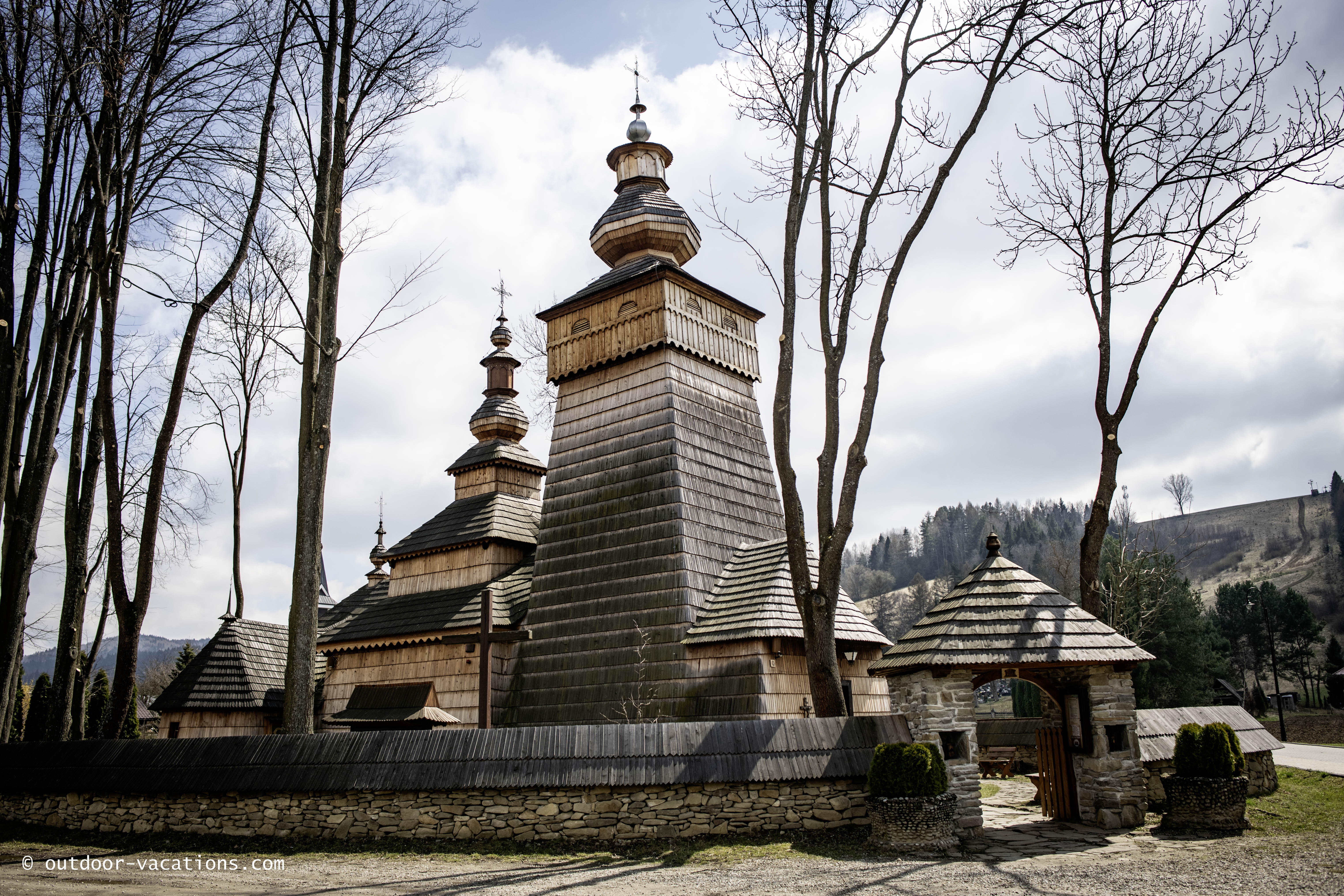
Good morning, today’s journey begins in Kraków, and it’s worth setting off as early as possible, ideally before the city stirs, to make the most of a day steeped in tradition and craftsmanship. After you’ll leave the cobbled streets of the Old Town behind and head south into the rural landscapes of Lesser Poland, where the Wooden Architecture Trail will unfold. This route is a quiet celebration of centuries-old artistry, winding through villages and small towns where timber churches, chapels, and houses still stand as testaments to a deeply rooted way of life.
Your first major stop is Chochołów, a remarkable village almost entirely built from hand-hewn logs, where wooden homes gleam with a silvery patina, lovingly preserved by generations. As you continue, the route passes through valleys framed by forested hills and leads to Zakopane, the highland town nestled at the foot of the Tatra Mountains. Here, the unique Zakopane style of wooden architecture, influenced by local folklore and mountain spirit, is on full display.
Further on, you’ll pass Nowy Targ, the cultural heart of the Podhale region, where you may want to pause and explore one of the oldest wooden churches in the area or visit a bustling local market. Throughout the day, the landscape shifts gently, from rolling meadows to pine forests and highland pastures, each revealing another piece of the wooden heritage woven into the land.
As the day comes to a close, you’ll have traversed not just distance, but time, through a world where the scent of timber and smoke still lingers in the air, and architecture speaks in the language of craft, memory, and mountain life.
—
Accommodation:
Hotel in Nowy Tarq
Optional extra attractions for this day:
– Kasprowy Wierch cable car
– Hiking in the Tatra
Day 2: Podhale – Beskid Sadecki
Nowy Tarq – Stary Sacz – Piwniczna – Krinica Zdroj
Good morning, today’s journey continues deeper into the southern reaches of Lesser Poland, weaving through a landscape where time seems to slow and the presence of tradition is almost tangible. Starting in Nowy Targ, the unofficial capital of the Podhale region, you’ll want to take a quiet morning walk through its historic center or stop briefly at one of its timeworn wooden churches, early examples of the distinctive highland craftsmanship you’ll continue to encounter throughout the day.
From here, the road leads eastward toward Stary Sącz, a town with a calm, contemplative air. Framed by mountains and the confluence of two rivers, Stary Sącz is a hidden gem where cobbled streets and wooden townhouses echo with centuries of quiet devotion. Be sure to visit the Monastery of the Poor Clares and the nearby wooden structures that form part of the region’s architectural heritage.
Continuing on, the journey flows with the curves of the Poprad River, guiding you to Piwniczna-Zdrój. This small spa town is surrounded by forested hills and known for its healing waters, but it also holds subtle architectural treasures, wooden villas and old guesthouses that speak of its past as a 19th-century retreat. It’s the perfect place to pause, perhaps for lunch, and take in the quiet rhythm of mountain life.
The day ends in Krynica-Zdrój, a renowned health resort nestled in the Beskid Sądecki mountains. Here, ornate wooden pavilions and fin-de-siècle guesthouses line leafy promenades, blending the charm of a bygone era with a sense of Alpine serenity. It’s an ideal place to settle in for the night, surrounded by the quiet elegance of wood, water, and mountains, and the lingering sense that you’ve traveled not just through space, but into the story of a region shaped by its natural beauty and enduring craft.
—
Accommodation:
Hotel in Krinica Zdroj
Optional extra attractions for this day:
Day 3: Beskid Sadecki – Beskid Niski
Krinica Zdroj – Beskid Niski
Good morning, today’s route leads you away from the spa town of Krynica-Zdrój and into the quiet, lesser traveled landscapes of the Beskid Niski, a region that feels like a well kept secret. It’s best to set off early, as the day invites a slower pace and time to absorb the gentle rhythm of the mountains and the subtle presence of history that lingers in the hills and valleys.
Leaving Krynica, you’ll notice the ornate wooden villas slowly giving way to wilder, more remote scenery. The road meanders through rolling pastures, thick forests, and scattered hamlets where life follows the pulse of the land. This is one of the most peaceful stretches of the Wooden Architecture Trail, where churches with onion-domed bell towers and finely carved details stand quietly among the trees, bearing witness to a rich multicultural past shaped by Lemko and Boyko traditions.
As you travel deeper into Beskid Niski, the architecture becomes more intimate small wooden chapels nestled on hillsides, abandoned cemeteries hidden in the woods, and modest farmhouses that blend seamlessly with the earth-toned landscape. The villages here names like Kwiatoń, Bartne, or Sękowa are fewer, the distances longer, and the silence more complete. Each stop offers a glimpse into a forgotten world where the craftsmanship of wood met the soul of a mountain people.
This part of the exploration isn’t just about seeing, it’s about sensing. The slow beauty of the Beskid Niski lies in its quietude, in the creak of a wooden floor, the scent of moss covered beams, the light filtering through forest canopy onto weathered roofs. By the end of the day, you’ll find yourself not just in a new place, but in a different state of mind one shaped by simplicity, nature, and a kind of timeless grace.
—
Accommodation:
Hotel in Beskid Niski
Optional extra attractions for this day:
Day 4: Beskid Niski – Bieszczady
Beskid Niski – Bieszczady
Good morning, today’s leg of the journey takes you from the gentle folds of the Beskid Niski into the wild, untamed beauty of the Bieszczady Mountains, arguably the most remote and poetic region of southern Poland. This is a day to embrace the spirit of discovery. The route winds southeast through valleys wrapped in mist, where villages grow sparser and the landscape grows bolder with each passing kilometer.
As you leave the Beskid Niski behind, you’ll pass through forgotten hamlets and wooden churches that seem to rise organically from the earth, some carefully preserved, others leaning into time and moss, their faded icons and hand-carved portals quietly echoing stories of faith, migration, and memory. The traces of Lemko heritage linger everywhere: in old cemeteries shaded by ancient trees, in roadside crosses, and in the curved silhouettes of traditional homes.
With every turn, the road begins to climb into the foothills of the Bieszczady. The air feels different here, clearer, thinner, quieter. You’re entering a region where nature takes precedence, where the silence is punctuated only by the call of a bird or the rustle of wind through high meadows. Wooden architecture still dots the trail, small Orthodox churches with weathered shingles and bulbous domes, tucked between beech forests and rivers, but here, it feels even more like part of the landscape itself.
As you reach the heart of Bieszczady, perhaps around Cisna or Wetlina, the day’s journey comes to a restful close in a place where the horizon stretches wide and the modern world feels far away. This is where solitude, tradition, and the rawness of the Carpathians meet. A fitting end to a day shaped by transition, between regions, histories, and states of mind.
—
Accommodation:
Hotel in Bieszczady
Optional extra attractions for this day:
Day 5: Bieszczady – Krakow
Traditional Rafting in Sanok – exploring and driving back to Krakow
Good morning, today marks the final chapter of your journey, a day of reflection and gentle return, tracing your path from the serene depths of the Bieszczady Mountains back to the lively streets of Kraków. It’s worth starting early, allowing time for one last immersion in the natural rhythms and cultural textures of the region before the road winds home.
Leaving the quiet beauty of the high meadows and forested slopes behind, your route leads toward Sanok, a town that sits like a threshold between wilderness and civilization. Before arriving, consider stopping at one of the scenic riverbanks along the San River for a traditional wooden raft ride, a peaceful, time-honored way of experiencing the landscape from a different perspective. Drifting past wooded hillsides and small villages, you’ll see the countryside as generations before have seen it: slowly, from the water, guided by the skillful hands of local rafters.
In Sanok itself, you’ll find a rich blend of history and craftsmanship. The open-air Museum of Folk Architecture is especially worth a visit, it houses one of the largest collections of wooden buildings in Poland, including relocated Lemko, Boyko, and Polish village homes, churches, and workshops that vividly capture the life and artistry of the region.
From here, the journey turns westward, and the road gradually carries you back toward Kraków. The terrain softens, the hills grow gentler, and the villages more frequent. It’s a drive made for quiet conversation or thoughtful silence, a time to absorb everything you’ve seen, the carvings and churches, the scent of pine, the layered voices of history carried in wood and stone.
Arriving in Kraków as evening settles in, you return not just to the place you began, but with a deeper sense of Poland’s cultural landscape, one shaped by tradition, craft, and the enduring beauty of the wooden trail you’ve followed.
—
Accommodation: not included
Optional extra attractions for this day:
Starting from: €xxx/per person